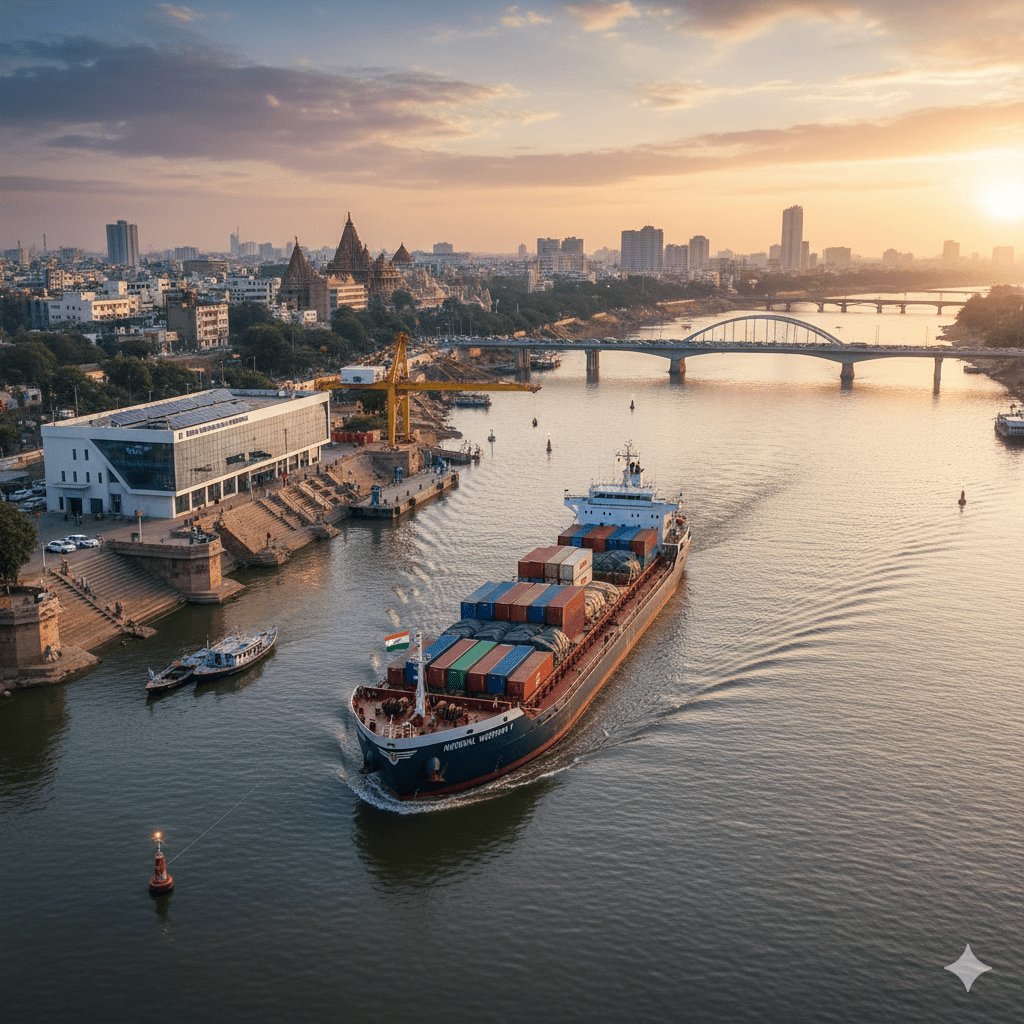
For decades, India’s economic engine ran primarily on roads and railways. While vital, these networks have struggled under the weight of burgeoning trade, leading to high logistics costs, congestion, and increased carbon emissions. Yet, India is quietly rediscovering an ancient, yet highly potent, form of transport: its vast network of rivers, canals, and backwaters. This is the story of India’s Inland Marine Progress a national movement to harness the power of its waterways, transforming them from scenic routes into the very arteries of commerce and sustainable growth.
The progress in the last decade has been nothing short of transformational. From just 3 operational National Waterways in the past, India now boasts over 29 operational waterways, with a total navigable network spanning over 14,500 km. The impact is quantifiable and staggering: cargo movement on inland waterways has soared by over 700% in the last ten years, signaling a decisive shift in India’s logistics landscape. This river-based revolution is not just about moving goods; it is about building a more efficient, resilient, and environmentally conscious future, guided by ambitious frameworks like the Maritime India Vision (MIV) 2030 and the long-term Maritime Amrit Kaal Vision 2047.
A New National Priority: The Vision and the Framework
The government’s comprehensive approach, spearheaded by the Ministry of Ports, Shipping and Waterways, views the maritime sector as a foundational pillar of the economy. Two key initiatives drive this inland focus:
1. The Sagarmala Programme: While primarily focused on port-led development and coastal shipping, Sagarmala acts as an umbrella strategy, ensuring seamless multimodal connectivity. The core objective is to reduce logistics costs for EXIM (Export-Import) and domestic trade to global benchmarks, and inland waterways are the critical link connecting ports to the hinterland.
2. The National Waterways Act: This landmark legislation officially declared 111 waterways as National Waterways (NWs), institutionalizing their development and maintenance under the Inland Waterways Authority of India (IWAI). This formalized structure unlocked significant public and private investment.
The Maritime India Vision 2030, a detailed roadmap, aims to invest massive capital—upwards of ₹3.5 lakh crore—to modernize ports, expand the Indian fleet, and, crucially, dramatically boost the share of cargo transported via inland and coastal shipping.
The Great Rivers: Engines of Economic Activity
The bulk of the inland marine progress is concentrated along India’s major rivers, which have been systematically developed into high-capacity trade corridors:
National Waterway 1 (NW-1): The Ganga-Bhagirathi-Hooghly River System
Stretching from Haldia to Prayagraj (1,620 km), NW-1 is the flagship project. It has seen the construction of world-class multi-modal terminals at Varanasi, Sahibganj, and Haldia, offering integrated road and rail connectivity. The introduction of modern barges and fixed navigational aids has made commercial movement reliable, demonstrating the viability of moving bulk cargo like coal, fertilizers, and food grains from the eastern ports deep into India’s densely populated northern plains.
National Waterway 2 (NW-2): The Brahmaputra River
The stretch from Dhubri to Sadiya (891 km) in Assam is a strategic and economic game-changer for the entire North Eastern Region (NER). The development of this waterway, along with key terminals like the one at Pandu (Guwahati), directly addresses the logistical challenges faced by the region due to difficult terrain. Moreover, its connection via the Indo-Bangladesh Protocol (IBP) Route is crucial for unlocking trade with Bangladesh, Bhutan, and Myanmar, strengthening India’s Act East policy.
Beyond Cargo: Enhancing User Experience and Skills
Progress in the inland marine sector is not limited to capacity augmentation; it’s also about building a robust ecosystem and delivering a better experience for citizens and businesses:
1. Infrastructure for Self-Reliance:
A major user-focused advancement is the development of indigenous ship repair infrastructure. New Ship Repair Facilities (SRFs) commissioned on the Ganga in Patna and Varanasi, with another coming up in Pandu (Guwahati), allow vessels to be maintained locally. This dramatically reduces vessel turnaround time, saving logistics companies money, reducing downtime for barges, and bolstering self-reliance under the Make-in-India framework for specialized maritime engineering.
2. Multimodal Logistics and Efficiency:
The core benefit of IWT to the user (i.e., the logistics industry) is reduced cost and complexity. By integrating waterways with rail and road at multimodal terminals, the government is creating seamless ‘last-mile’ connectivity. Private players are encouraged to participate, bringing global best practices. For instance, recent MOUs signed with international logistics firms involve deploying scores of specialized barges on NW-1 and NW-2, targeting the movement of over a million tonnes of cargo annually in the initial phase. This infusion of global expertise and capital is accelerating the adoption of IWT as the preferred mode of bulk cargo.
3. Cruise and Tourism Potential (Cruise Bharat Mission):
The progress also extends to passenger experience. The launch of the Cruise Bharat Mission and the River Cruise Tourism Roadmap, 2047, aims to position India on the global cruise map. Services like the successful Ganga Vilas, the world’s longest river cruise, showcase the potential of using these developed waterways for high-end tourism. This generates employment, fosters coastal economic activity, and introduces tourists to India’s heartland in an immersive new way.
The Triple Bottom Line: Economy, Environment, and Efficiency
The surge in inland marine activity brings profound benefits across three critical dimensions:
- Economic Advantage: Water transport is significantly cheaper than road or rail for bulk cargo. The shift to IWT directly contributes to lowering India’s notoriously high logistics costs, making Indian products more competitive globally. The massive investment commitment, alongside the growing net annual surplus of ports (which has grown nine-fold in a decade), signals strong fiscal health in the sector.
- Environmental Sustainability: Water transport is the most eco-friendly mode of surface transport. It has a fraction of the carbon footprint compared to road transport. The government’s focus on initiatives like the Green Tug Transition Programme and the adoption of electric cranes and renewable energy at ports ensures the expansion of the maritime sector is aligned with the national goal of achieving Net Zero by 2070.
- Logistics Efficiency: Enhanced IWT has contributed to the massive improvement in India’s overall logistics performance. The average container dwell time has dropped significantly, placing Indian ports on par with or better than many developed nations.
Conclusion: Full Steam Ahead to Maritime Amrit Kaal
India’s inland marine progress is a story of national renaissance—a journey from underutilized heritage to modern economic powerhouse. The shift is already delivering concrete results: a 700% increase in cargo, a massive expansion of the operational network, and the integration of world-class repair and logistics infrastructure.
The path ahead, defined by the Maritime Amrit Kaal Vision 2047, is focused on continued investment, green shipping technologies, and further expansion of the waterway network. By continuing to leverage its natural geography and pairing it with smart, modern infrastructure, India is ensuring its rivers flow not just with water, but with the unstoppable tide of economic opportunity.
Summary
| Category | Component | Key Detail/Example | Impact & Benefit (The “Why”) |
|---|---|---|---|
| I. Overview & Scale | The Transformation | Operational waterways increased from 3 to over 29. Total navigable network: 14,500+ km. | Showcases massive scale-up and national commitment to IWT as a primary logistics mode. |
| Cargo Growth | Cargo movement on IWT has increased by over 700% in the last decade. | Confirms IWT viability; signifies a major shift in logistics preference and efficiency. | |
| II. Core Strategy | Vision Frameworks | Maritime India Vision (MIV) 2030 and Maritime Amrit Kaal Vision 2047. | Provides a clear, long-term roadmap for investment and modernization. |
| Key Legislation | National Waterways Act, declaring 111 waterways as NWs. | Institutionalized development and unlocked government and private investment. | |
| III. Flagship Projects | NW-1 (Ganga) | Haldia to Prayagraj (1,620 km). Built multi-modal terminals at Varanasi, Sahibganj, and Haldia. | Creates a high-capacity trade corridor for bulk cargo into the populous Northern plains. |
| NW-2 (Brahmaputra) | Dhubri to Sadiya (891 km). Connected via the Indo-Bangladesh Protocol (IBP) Route. | Strategic economic artery for the North Eastern Region (NER) and unlocks international trade with neighbors. | |
| IV. User Experience & Ecosystem | Ship Repair Infrastructure | New Ship Repair Facilities (SRFs) commissioned in Patna, Varanasi, and Pandu (Guwahati). | Reduces vessel downtime and maintenance costs; promotes maritime self-reliance (Make-in-India). |
| Multimodal Integration | Linking waterways directly with rail and road at multimodal terminals. | Ensures seamless ‘last-mile’ connectivity, reducing overall logistics cost and complexity for businesses. | |
| Tourism | Cruise Bharat Mission and successful operations like the Ganga Vilas. | Generates new employment, fosters river-side economic activity, and positions India on the global cruise map. | |
| V. The Triple Benefit | Economic Advantage | IWT is significantly cheaper for bulk cargo compared to road/rail. | Lowers India’s logistics costs, making domestic and EXIM products more globally competitive. |
| Environmental Edge | Water transport has a fraction of the carbon footprint compared to road transport. | Supports India’s Net Zero by 2070 commitment and promotes a sustainable transport sector. | |
| Efficiency | Adopting global best practices; average container dwell time has dropped significantly. | Achieves **global benchmarks** in port and logistics performance, signaling operational maturity. |
 Capt Cibeesh
Leave a comment